
My research focuses on the study of biological diversity (biodiversity) from both ecological and evolutionary perspectives. I am interested in how ecological interactions, e.g. mutualisms, shape complex ecological systems. Interactions, such as those among plants and their seed dispersers and pollinators, are the wireframe of biodiversity, yet we are far from understanding how they evolve and coevolve. My main research tools to address this fascinating theme include field ecology, molecular genetics, and theoretical ecology.
Summary CV · Google Scholar · ResearchGate · WordPress · @pedro_jordano · GitHub
Papers — Pedro Jordano
Highlighted papers
Jordano, P. (2026). The ecological interactome: understanding Biodiversity through patterns of interactions. Annual Review of Ecology, Evolution, and Systematics, 57, 51–76.
doi: 10.1146/annurev-ecolsys-102824-110132
González-Varo, J.P., Arroyo, J.M., and Jordano, P. 2014. Who dispersed the seeds? The use of DNA barcoding in frugivory and seed dispersal studies. Methods in Ecology and Evolution 5: 806–814.
doi: 10.1111/2041-210X.12212
Jordano, P. (2014). Fruits and frugivory. In: Seeds: the ecology of regeneration in plant communities (ed. Gallagher, RS). Commonwealth Agricultural Bureau International Wallingford, England, pp. 18–61.
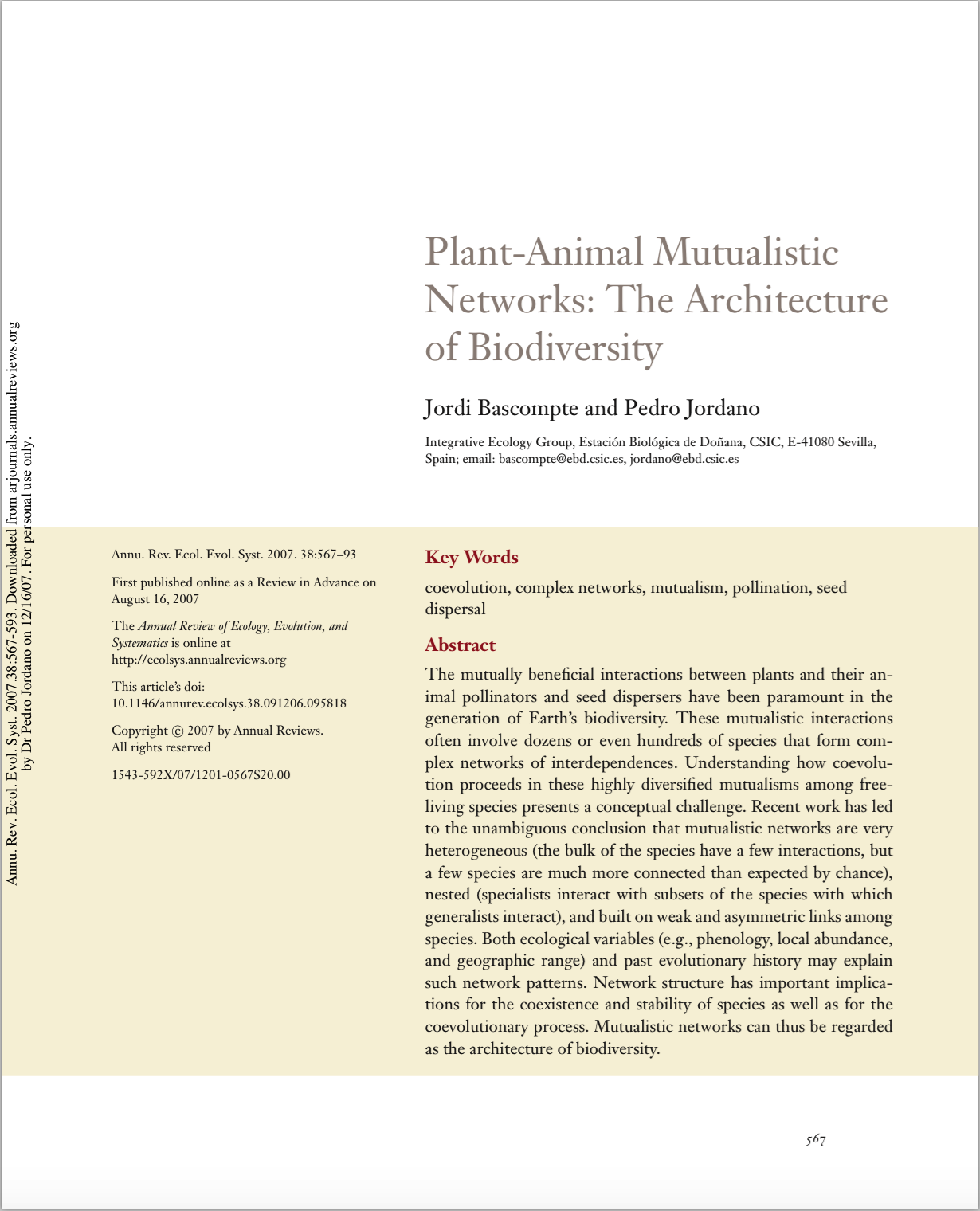
Bascompte, J. and P. Jordano. 2007. The structure of plant-animal mutualistic networks: the architecture of biodiversity. Annual Review of Ecology, Evolution, and Systematics 38: 567–593.
doi: 10.1146/annurev.ecolsys.38.091206.095818
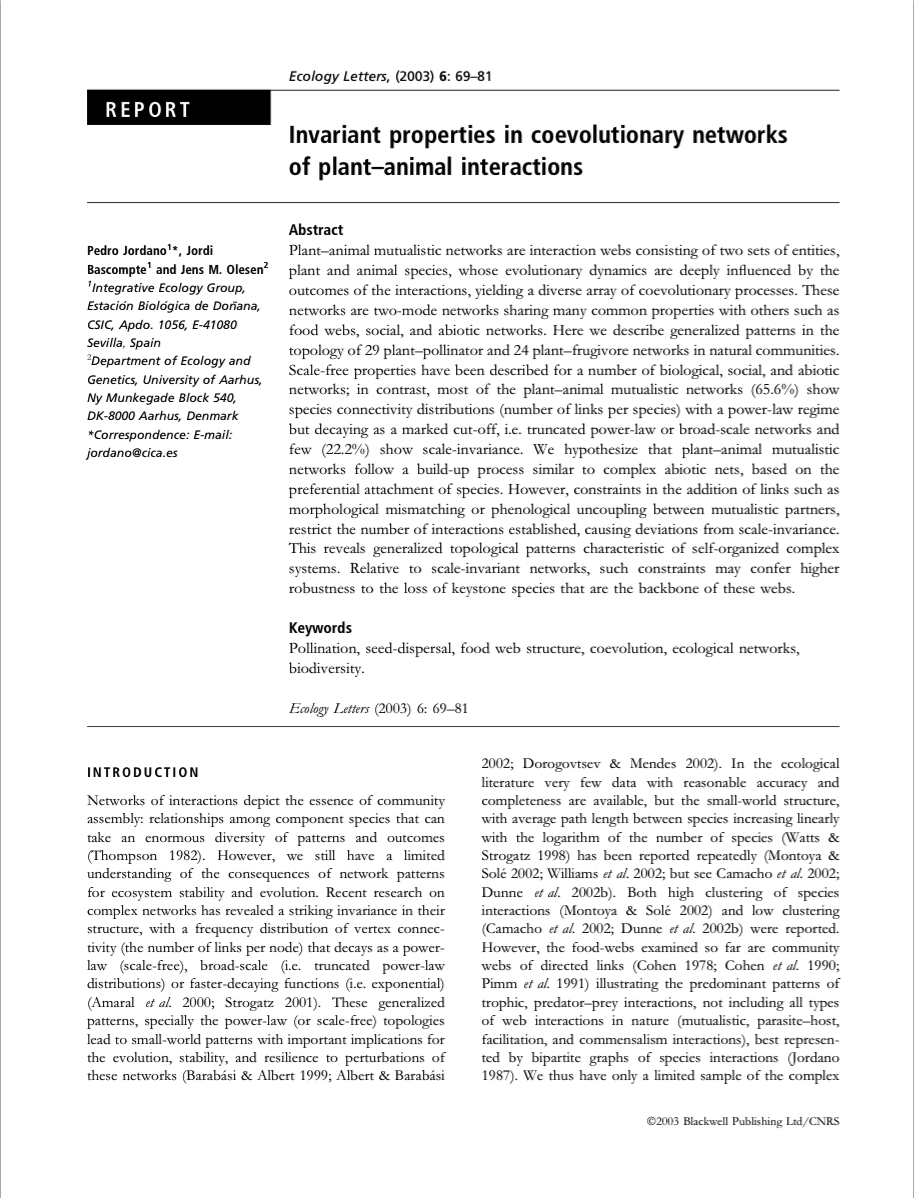
Jordano, P., J. Bascompte and J.M. Olesen. 2003. Invariant properties in coevolutionary networks of plant-animal interactions. Ecology Letters 6: 69–81.
doi: 10.1046/j.1461-0248.2003.00403.x
J. Bascompte and P. Jordano. 2013. Mutualistic networks. Monographs in Population Biology, Princeton University Press, NJ.
Chapter 1.